Penalty exposure removed
Registration, filing and payment deadlines tracked and met. No AED 10,000 surprises for something entirely avoidable.
Corporate tax registration with the FTA, Small Business Relief elections, Qualifying Free Zone Person assessment, transfer pricing and annual filing — handled by chartered accountants who also sign the audit.
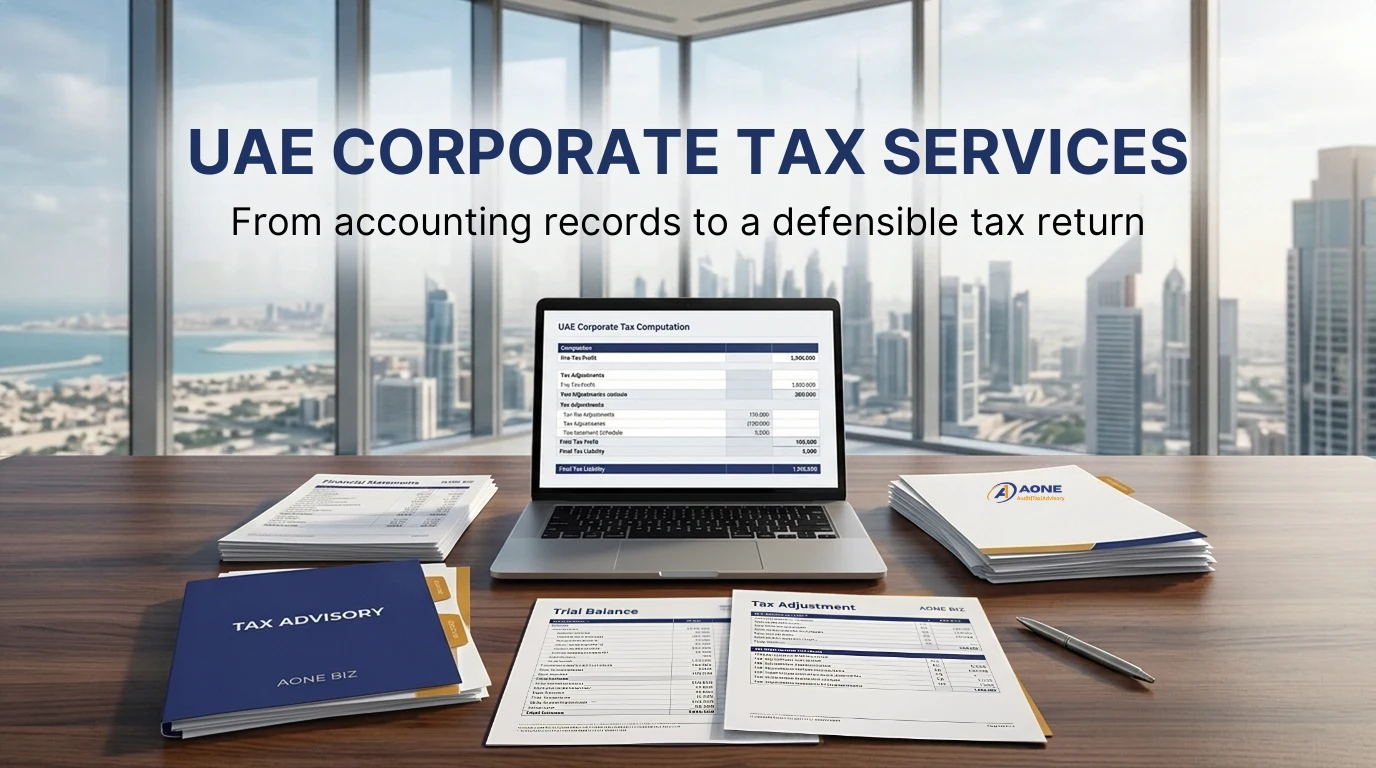
UAE corporate tax is calculated from accounting profit adjusted for specific items. That means the quality of your return is decided months earlier, by the quality of your bookkeeping — not by the person who fills in the form in month nine.
This is where most businesses come unstuck. Books maintained loosely through the year produce a figure nobody can defend under scrutiny. Related-party charges are posted without documentation. Free zone entities assume the 0% rate applies without ever testing the conditions. Elections that had to be made in a specific period are missed entirely.
AONE BIZ works the other direction. We structure the chart of accounts to support tax reporting, maintain the books to IFRS through the year, and arrive at the return with a file that is already defensible. If the FTA asks a question, the answer is already documented.
Beyond avoiding penalties — a tax position you can explain, defend and plan around.
Registration, filing and payment deadlines tracked and met. No AED 10,000 surprises for something entirely avoidable.
Small Business Relief, qualifying free zone treatment and group relief assessed properly — and elected in the correct period.
Computations backed by reconciled ledgers, supporting schedules and documented positions. Retained for the full seven years.
You see the likely tax charge during the year, not in month nine. That changes how you plan distributions and reinvestment.
A clean FTA record and audited numbers materially smooth bank reviews, investor diligence and licence renewals.
The people who keep your books, file your return and sign your audit are the same people. One version of your numbers.
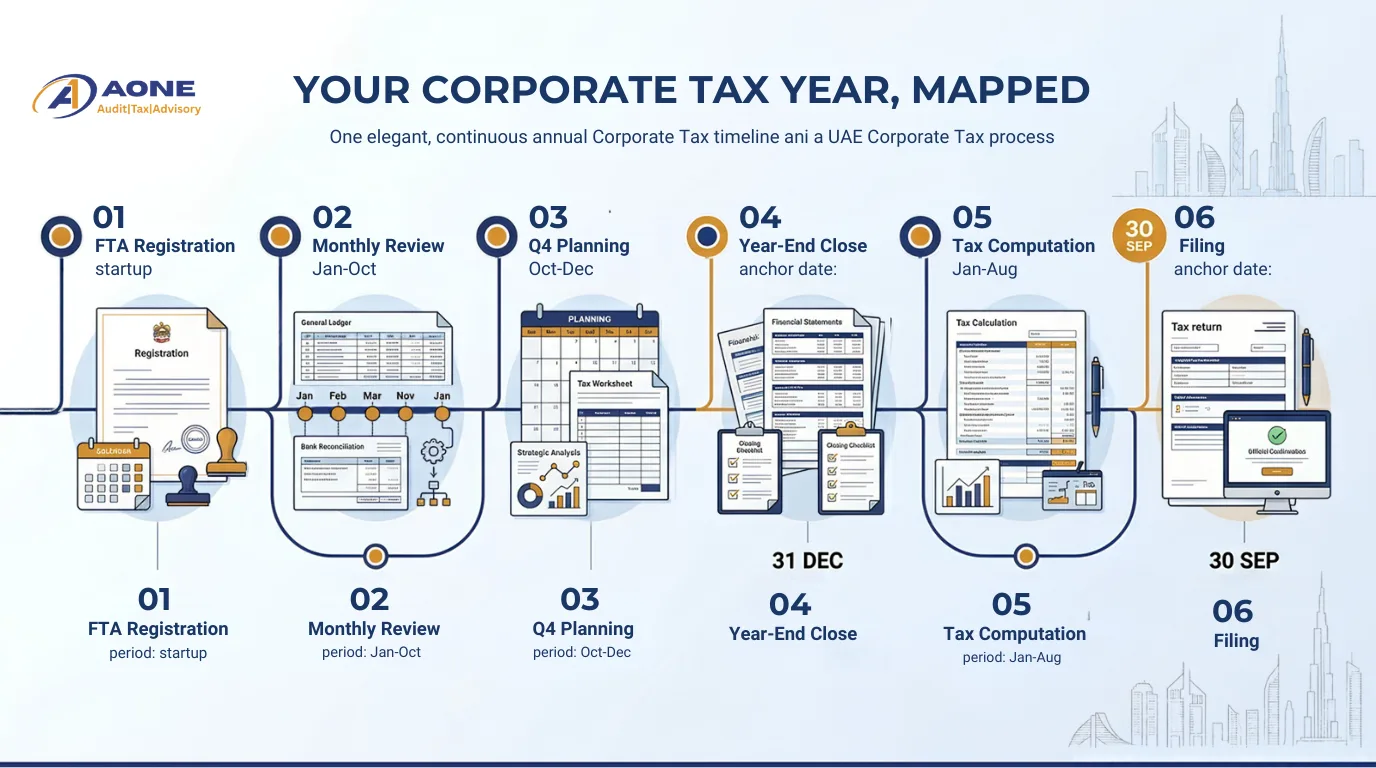
A year-round process, not a nine-month scramble.

We review your entity type, jurisdiction, income streams and group structure to establish which rate and reliefs actually apply to you.
FTA registration through EmaraTax, tax period aligned to your financial year, and the relevant elections identified and diarised.
IFRS-compliant records maintained monthly, with tax-sensitive items — related-party charges, disallowables, exempt income — flagged as they arise.
Taxable income calculated with full adjustments, return prepared and filed within the deadline, and the supporting file archived for seven years.
Illustrated for a company with a 31 December financial year end.
Not the return itself — the accounting behind it. Companies that reach month nine with unreconciled ledgers spend six weeks rebuilding before the computation can start. We work to an internal close date well inside the deadline.
New entities register and obtain a Corporate Tax Registration Number. Deadlines are tied to licence issue date.
Transactions posted, banks reconciled, related-party items documented as they occur rather than reconstructed later.
Provisional tax position reviewed, relief eligibility confirmed and any structural adjustments made before the year closes.
Financial statements finalised to IFRS and, where required, audited by our licensed audit team.
Taxable income computed with adjustments, elections applied and transfer pricing disclosure prepared.
Return submitted through EmaraTax and any liability settled. Supporting file archived for the seven-year retention period.
Priced on transaction volume and structural complexity, not on your revenue.
From AED 1,500
For businesses that keep their own books and need registration handled correctly.
From AED 6,500
For established companies wanting the full computation and filing handled.
Custom
Bookkeeping, VAT, corporate tax and audit delivered as one integrated service.
Fees depend on transaction volume, number of entities, group structure and whether historical records require reconstruction. Ranges shown are indicative for planning and do not constitute a binding offer. This page is general information, not tax advice — request a written engagement scope for advice specific to your circumstances.
The cleaner the underlying records, the faster and cheaper the filing.
Every taxable person registers — including free zone companies, loss-making businesses and dormant entities holding a live licence.
If you charge management fees between your own entities, pay yourself director remuneration, or lend between group companies, transfer pricing rules apply to you.
UAE corporate tax requires transactions with related parties and connected persons to meet the arm's length standard. Where prescribed thresholds are met, a master file and local file must be maintained. Below those thresholds, a disclosure form still accompanies the return and the FTA may request supporting evidence at any point.
The practical exposure is that a group structure built for operational convenience — an intra-group service charge set at a round number, a shareholder loan with no interest, a licence fee to an overseas parent — becomes a documented tax adjustment under review. We benchmark those charges and build the supporting file before it is requested, not after.
Discuss Your Group StructureA tax return is only as strong as the accounting behind it. We control both.
The computation is prepared by the people who maintain your ledgers and understand every balance in them.
Licensed auditors in-house means your financial statements and your tax return tell the same story — because they come from the same file.
We test Qualifying Free Zone Person status against your real income streams rather than assuming the 0% rate applies.
Positions are documented when they arise. If the FTA asks in year three, the evidence already exists.
Registration, filing and payment dates tracked in our compliance calendar with escalation well before they land.
If the FTA raises a query or opens an assessment, the team that prepared the return handles the response.
Four moments where advice changes the outcome rather than just filing the form.
Corporate tax advice is worth paying for at the points where the answer changes what you do, not simply to have a return submitted. In practice that means four moments.
If something has already gone wrong, correcting it through voluntary disclosure before the FTA finds it almost always costs less than being assessed.
Corporate tax registration is mandatory for every UAE company, including free zone entities claiming the 0% rate and companies making no profit at all. Registration and payment are separate questions, and confusing the two is the most expensive mistake we see.
The corporate tax registration deadline depends on your licence issue date, and the penalty for missing it is AED 10,000 regardless of your tax position — a dormant company with no income pays exactly what a profitable one pays. Our guide to the late registration penalty covers whether it can be waived, and the full deadline calendar sets out what falls due when.
To register you need your trade licence, memorandum, Emirates ID and passport for authorised signatories, and your financial year end confirmed. It is done through the FTA’s EmaraTax portal. A corporate tax consultant earns their fee less in the registration itself — which is genuinely straightforward — than in what follows: the qualifying income analysis, related party disclosure, and the accounting policy decisions that determine what you actually pay. We act as corporate tax advisors across all of it.
Straight answers, with the caveats that actually matter.
Every taxable person must register with the Federal Tax Authority and obtain a Corporate Tax Registration Number — including free zone companies expecting a 0% rate, companies making losses, and dormant entities that still hold a valid licence. Registration is not optional and is not triggered by profitability. Late registration attracts an administrative penalty of AED 10,000.
The headline structure is 0% on taxable income up to AED 375,000 and 9% on taxable income above that threshold. A separate 0% rate applies to qualifying income of a Qualifying Free Zone Person that meets all the prescribed conditions. Large multinational groups within scope of the OECD Pillar Two rules face a different global minimum tax treatment. Which rate applies to you depends on entity type, jurisdiction and income composition — it is worth confirming rather than assuming.
Small Business Relief allows a resident taxable person whose revenue does not exceed AED 3 million in the relevant tax period, and in all previous tax periods since it became available, to elect to be treated as having no taxable income for that period. It is an election you must actively make in your return — it is not applied automatically. Qualifying Free Zone Persons and members of large multinational groups are excluded. We assess eligibility and make the election correctly as part of your filing.
The return and any payment are due within nine months of the end of your tax period. A company with a financial year ending 31 December 2025 therefore has a filing deadline of 30 September 2026. There is no extension mechanism in ordinary circumstances, and late filing and late payment carry separate penalties. We work backwards from your deadline and set an internal close date with real margin.
No — and this is the most costly misunderstanding we encounter. The 0% rate applies only to qualifying income of a Qualifying Free Zone Person, and requires adequate substance in the free zone, income falling within prescribed qualifying categories, compliance with transfer pricing documentation, and non-qualifying revenue staying inside the de minimis limits. Breach any condition and the entity is taxed at 9% on all taxable income above the threshold, potentially for multiple years. We test qualifying status against your actual income streams.
If you transact with related parties or connected persons, those transactions must meet the arm's length standard and be supported. Full documentation — a master file and local file — is required where prescribed revenue or group thresholds are met. Even below those thresholds, a disclosure form must accompany the return and the FTA can request supporting evidence. Related-party charges such as management fees, director remuneration and intra-group loans attract particular scrutiny.
Records and supporting documentation must be retained for seven years following the end of the relevant tax period. That means financial statements, general ledger, invoices, contracts, bank statements, related-party agreements and any documents supporting elections or exemptions claimed. In practice this means proper accounting throughout the year — reconstructing seven years of records after an FTA query is not a viable plan.
Yes. We register you with the FTA, structure your chart of accounts to support tax reporting, maintain the books, prepare IFRS-compliant financial statements, calculate taxable income with all adjustments, make the appropriate elections, file the return and hold the supporting file for the seven-year retention period. If the FTA raises a query, the same team that prepared the return responds to it.
Most clients pair this service with one or more of the following.
IFRS-compliant monthly records — the foundation every corporate tax return is built on.
Audited statements are the strongest support for a corporate tax computation if the FTA opens an assessment. We sign them in-house, from the same file.
Qualifying Free Zone Person status starts with the right zone and the right substance.
Send us your licence and last set of accounts. We will confirm your registration status, likely rate and any relief you should be claiming.
Whether you need registration, a first filing, or a review of a position someone else took — send us the details and we will tell you plainly where you stand.
Takes under a minute. No obligation, no sales script.
Tell us where you are in the process. We will come back with the right jurisdiction, a realistic cost range and a timeline — no obligation.
[aone_form type="modal"]