
Backlogged books are common and entirely fixable. What is not fixable is doing it in the wrong order — and the most expensive version of this work is the one that gets done twice because someone started with the tax return instead of the bank.
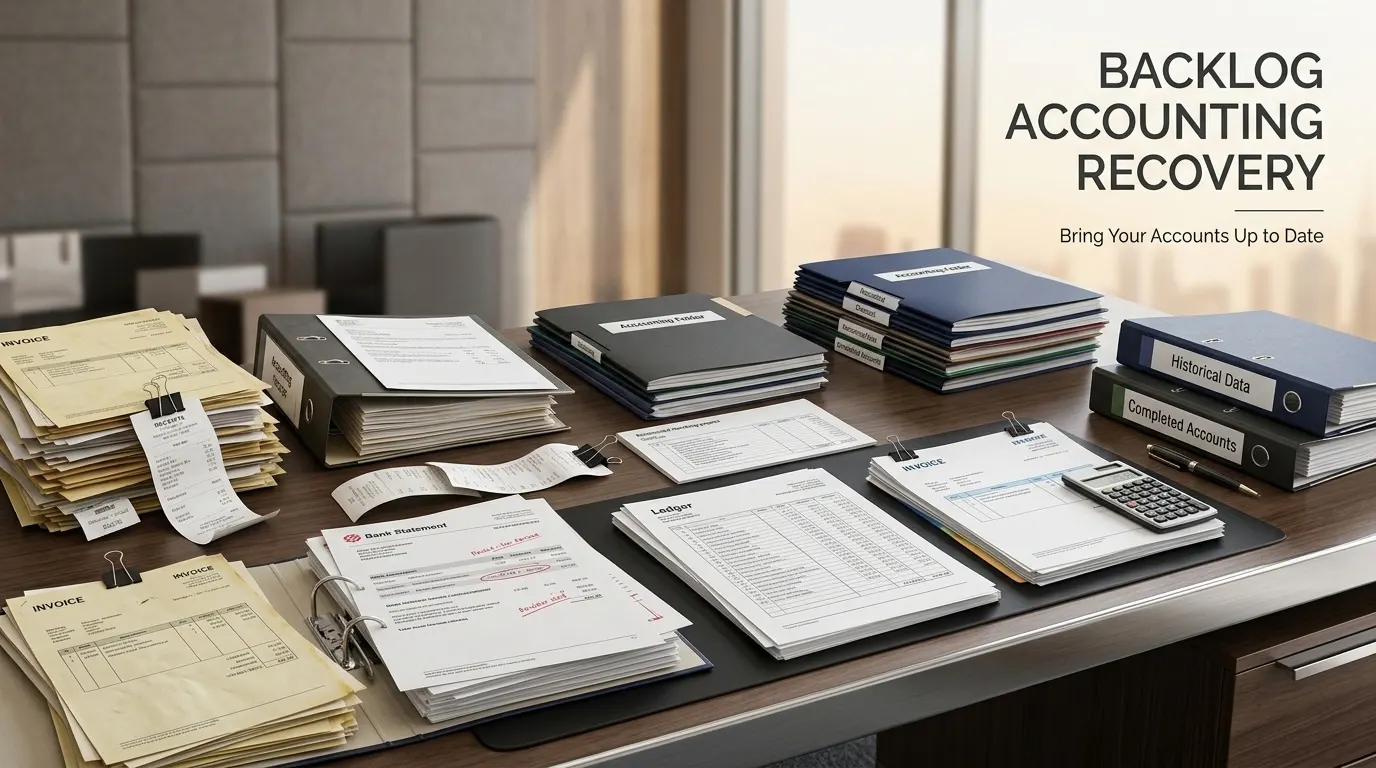
What backlog accounting services actually do
Rebuilding an incomplete or unreconciled set of records so they can support an audit and a tax return. It is reconstruction with evidence, not data entry — every figure has to be traceable to something.
Most engagements arrive for one of three reasons: a corporate tax deadline that cannot be met with the current records, a free zone renewal requiring audited accounts, or a previous provider who went quiet leaving nobody sure what was filed.
The correct sequence
- Bank reconciliation. Every account, every month, fully identified and categorised.
- Sales and purchases. Match invoices to receipts and payments; identify what is genuinely missing rather than assuming.
- Balance sheet reconciliation. Fixed assets, loans, related party balances, accruals, gratuity.
- VAT reconciliation. Agree filed VAT returns to rebuilt revenue and quantify differences.
- Tax positions. Only now can corporate tax and free zone qualifying income be assessed reliably.
- Audit. With reconciled books, the audit is a review rather than a second reconstruction.
Why the bank comes first
The bank statement is the only record you did not create. Every other document — invoices, ledgers, spreadsheets — was produced internally and can be incomplete. The bank is external, complete and dated.
So bank reconciliation is not first because it is easiest. It is first because it is the only fixed point. Once every transaction is identified, you know the true perimeter of the business: total in, total out. After that nothing can be missing — only misclassified, which is a far smaller problem than omission.
What “missing” usually means
In most engagements, records are not truly lost. They are somewhere nobody looked: a personal email account, a former bookkeeper’s laptop, the supplier’s portal, or a payment platform nobody mentioned.
Before treating anything as unrecoverable we check bank narratives for counterparty names and request duplicates directly. Suppliers reissue invoices readily; payment processors export full histories. A methodical recovery pass typically resolves the large majority of apparent gaps, and every document recovered is stronger than an estimate.
Handling genuinely unrecoverable items
Where a document truly cannot be obtained, we document the estimate rather than leaving a gap: what the payment was, the basis for the treatment, what was attempted to recover evidence, and who approved the judgement.
A reasoned, documented estimate is defensible under review. An unexplained figure is not. The difference is not accuracy — it is whether a contemporaneous record exists of how you arrived at it. This matters directly because failing to produce records supporting a return is penalised in its own right.
Multi-year backlogs
Always oldest year first. Closing balances become opening balances, so an unresolved 2023 makes 2024 and 2025 unreliable no matter how carefully they are rebuilt.
This feels wrong when the deadline is on the current year, and the temptation to start there is strong. Resist it — rebuilding the current year on unverified opening balances produces figures that will not survive an audit, and the work gets done twice.
When the rebuild changes a filed position
Reconstruction frequently reveals that a previously filed return was wrong — revenue understated because an account was omitted, or VAT treated as out of scope when it was standard rated.
That is correctable. Voluntary disclosure before the FTA finds the error almost always costs less than being assessed, and the advantage largely disappears once an audit opens. We quantify the full extent across every affected period before submitting anything, because a partial disclosure followed by a second one is worse than one complete submission.
How long it takes
A single year of moderate volume is typically four to eight weeks, longer where bank statements or invoices are missing. Multi-year backlogs run year by year.
The variable that moves the estimate most is not transaction count — it is how many source documents exist. We scope after seeing the actual position rather than quoting blind, because a blind quote on backlog work is a guess that gets revised upward.
Staying current afterwards
Backlog recovery is worth doing once. Most clients move onto monthly bookkeeping afterwards, because the alternative is rebuilding the same exposure next year at the same cost.
With e-invoicing arriving, annual reconstruction stops being viable regardless — the authority will hold invoice-level data continuously, and records assembled after the fact cannot reconcile to it.
Frequently asked questions
No. Opening balances come from the prior year. An unreconciled prior year contaminates every year after it.
We reconstruct from bank and counterparty records and document the basis. A documented estimate is defensible; a silent gap is not.
Sometimes. If the rebuild shows a filed return was wrong, voluntary disclosure is usually cheaper than waiting for the FTA to find it.
It depends on source documents available rather than transaction count. We scope after seeing the actual position rather than quoting blind.
Yes, subject to independence considerations. Many clients prefer one team so the rebuild is done to the standard it will be tested against.
As far as required to support filed and outstanding returns, and to establish reliable opening balances for the current year.
Getting started
Tell us how many years are outstanding, how many bank accounts are involved, and what has already been filed. We will scope the work in the right order and quote it fixed.