
A general trading licence lets you trade a wide range of products under one licence, rather than being limited to specific categories. It costs more than a standard commercial licence, and for a business whose product mix will change, it usually pays for itself the first time you avoid an activity amendment.
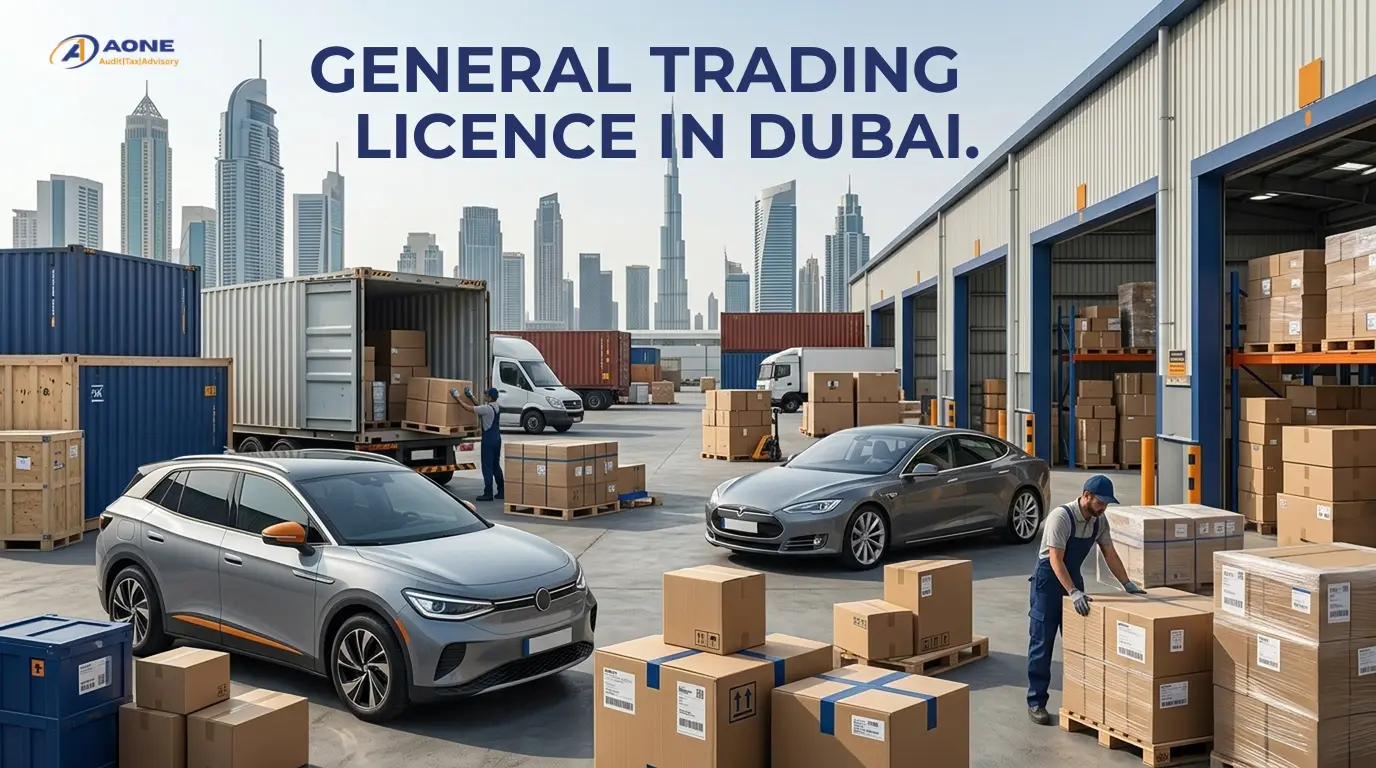
What a general trading licence Dubai permits
Trading in most categories of goods without needing a separate activity for each. It is the broadest trading permission available, which is why importers, distributors and diversified traders default to it.
It is not unlimited. Restricted and regulated goods sit outside it and need specific approvals regardless of how broad your licence is — pharmaceuticals, medical devices, food, cosmetics, telecoms equipment, firearms, tobacco and alcohol among them. A general trading licence does not substitute for a health authority or municipality approval.
General trading vs commercial licence
- Commercial licence — cheaper, limited to the specific activities listed. Right when your product range is defined and stable.
- General trading — more expensive, covers a wide range. Right when your mix will change, or when you cannot predict what you will source next year.
The calculation is simple. If you expect to add product categories, compare the general trading premium against the cost and delay of amending activities each time. For most importers the premium wins.
What it costs
- Mainland general trading — above a standard commercial licence, plus premises, Ejari and the 5% market fee on rent
- Free zone general trading — available at most zones, priced above their standard commercial licence
- Premises — warehousing costs dominate for stock-holding businesses; RAKEZ is materially cheaper than Dubai for space
- Each visa — roughly AED 3,500 to 5,500 including medical and Emirates ID
For trading businesses the licence is rarely the largest line. Warehousing, customs and working capital are. Model three-year cost including premises — the guide to Dubai setup costs covers the rest.
Customs, duty and the mainland question
You need a customs client code to import in your own name. Without it, shipments cannot clear.
Goods in a free zone are generally treated as outside UAE customs territory until they enter the mainland market. Moving them in triggers duty and clearance, and requires a mainland importer or distributor arrangement. This is the central structural question for a UAE-facing trading business, and it interacts directly with tax.
Why traders should decide jurisdiction on tax
Revenue from mainland UAE customers is generally not qualifying income for a Qualifying Free Zone Person. Distribution into the local market is precisely the activity that breaches the de minimis threshold.
Take a trader turning over AED 8 million with AED 600,000 from mainland customers. That is 7.5%, above the 5% threshold — and the consequence is loss of 0% status on the entire AED 8 million, not just on the AED 600,000. Against that, the difference in licence cost is noise. Read free zone corporate tax before choosing on price.
VAT and gross turnover
Trading businesses cross the mandatory VAT registration threshold quickly because it is measured on turnover, not margin. A distributor with 4% margins and AED 5 million of sales is well past it.
Imports carry reverse charge treatment, and exports may be zero rated with the right evidence. Getting documentation right at the point of transaction is far cheaper than reconstructing it — and your auditor will reconcile VAT returns to audited revenue, where a mismatch is a common FTA query trigger.
Inventory is where audits go wrong
For a trading business, stock is usually the largest balance sheet item and the hardest to audit.
Count it at year end and keep the sheets. A missed count cannot be reconstructed afterwards, and it leads directly to a qualified opinion — which affects licence renewal, bank facilities and your corporate tax position at once. Valuation matters too: stock is carried at the lower of cost and net realisable value, so slow-moving goods need writing down rather than carrying at cost indefinitely.
Maintained bookkeeping with periodic cycle counts avoids nearly all of this.
Frequently asked questions
A commercial licence is limited to specified activities. General trading covers a wide range of goods under one licence, at a higher fee.
No. Restricted and regulated goods - pharmaceuticals, food, cosmetics, telecoms equipment and others - need specific approvals regardless.
Yes, to import in your own name. Shipments cannot clear without one.
Yes, at most zones, priced above their standard commercial licence.
Only through a distributor or mainland entity, with duty and clearance on entry. That revenue is also generally non-qualifying for corporate tax.
It is usually the largest balance and the hardest to verify. A missed year-end count cannot be fixed later and typically results in a qualified opinion.
Getting started
Tell us what you intend to import, where it is going, and how much space you need. Those answers drive licence type, jurisdiction, customs and the tax position together.