Penalties stop accruing
An abandoned licence continues generating late-renewal penalties indefinitely. Liquidation is what actually stops the clock.
Company liquidation in the UAE is a sequence of clearances, not a single form. Abandoning a licence instead of liquidating leaves penalties accruing — against the shareholders personally.
This is the single most expensive misunderstanding we deal with. A business stops trading, the owner stops paying the renewal, and everyone assumes it is over. It is not. The entity remains on the register, the licence accrues late-renewal penalties, immigration and labour files stay open, and the corporate tax and VAT filing obligations continue.
Owners discover this years later — when they try to set up a new company, apply for a visa, or a penalty notice reaches them. By then the accumulated liability can exceed what a proper liquidation would have cost several times over.
Liquidation is a defined legal process: appoint a licensed liquidator, publish the required notice, settle liabilities, obtain clearance from every authority the entity touched, produce a final audited liquidator report, and cancel the licence. We run all of it, and we hold the audit licence needed to sign the report.

The cost of doing it correctly is fixed and known. The cost of not doing it is neither.
An abandoned licence continues generating late-renewal penalties indefinitely. Liquidation is what actually stops the clock.
Directors and shareholders can carry residual exposure for an entity that was never properly closed.
Open immigration files and unclosed labour cards create problems on your next visa or company application.
Corporate tax and VAT registrations must be deregistered. Otherwise filing obligations continue against a dead company.
Dormant accounts attached to a lapsed entity create compliance flags that follow the signatories.
A final liquidator report and cancellation certificate — the evidence you will need if anyone ever asks.
A defined legal sequence. Each clearance depends on the one before it.
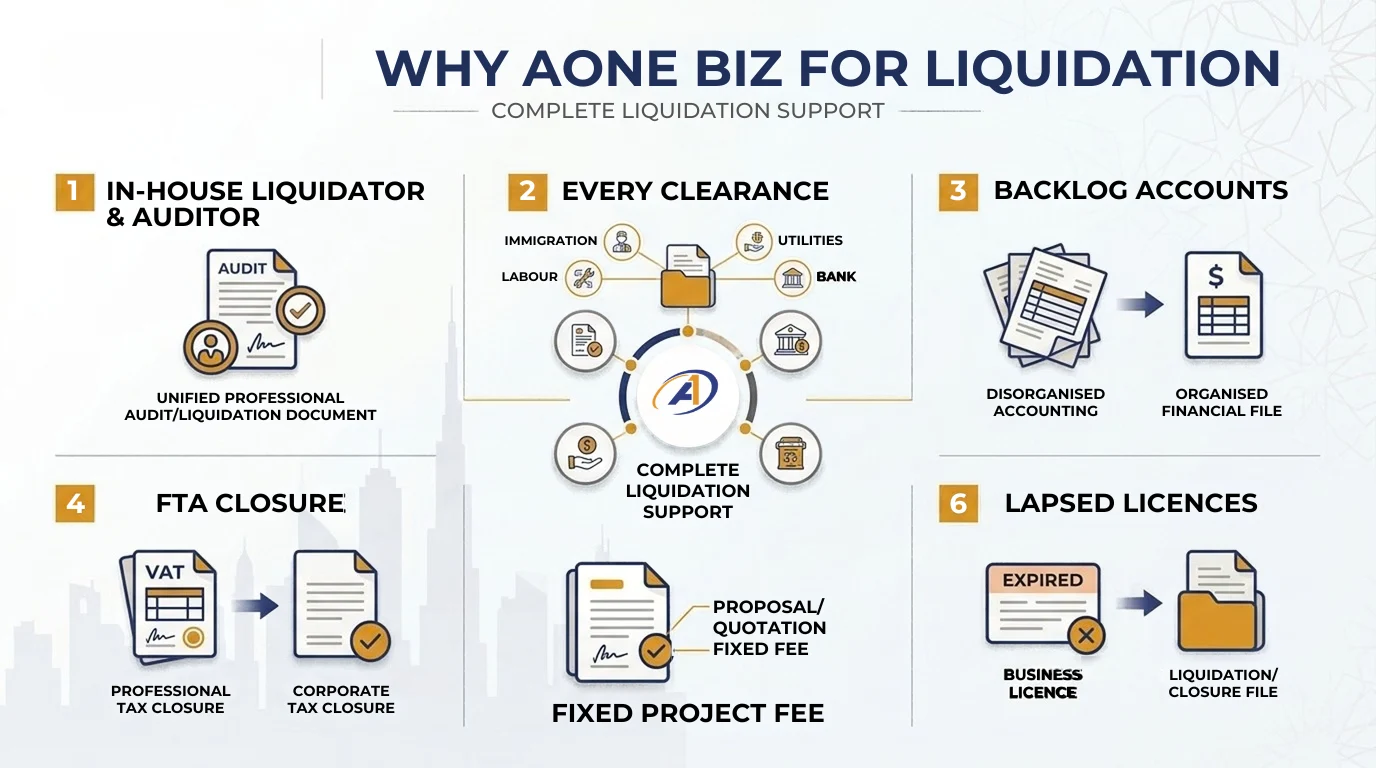
Shareholders resolve to dissolve, a licensed liquidator is appointed and formally accepts, and the initial application is filed with the authority.
The statutory notice is published and the creditor period runs. Liabilities are settled, receivables collected and assets realised.
Immigration file closed, labour cards cancelled, utilities and tenancy cleared, FTA deregistration completed, and the bank account closed.
The liquidator issues the final audited report, the authority cancels the licence, and the cancellation certificate is issued to you.
Free zone closures are usually faster than mainland. The notice period is fixed and cannot be shortened.
A single missing clearance. Immigration, labour, utilities, landlord, bank and FTA all have to sign off, and the cancellation stops dead at whichever one was overlooked. We work the list in sequence and chase each in turn.
Shareholder resolution notarised, liquidator appointed, initial application submitted.
Statutory notice published and the creditor objection period begins.
Visas cancelled, immigration and labour files closed, utilities and tenancy settled, FTA deregistration filed.
Closing accounts prepared and the liquidator report audited and signed.
Final submission to the authority and issue of the cancellation certificate.
Quoted as a fixed project fee after scoping, so a closure does not become open-ended.
From AED 9,500
Free zone entity with no employees and a simple balance sheet.
From AED 14,000
Mainland entity with visas, tenancy and a bank account to close.
Custom
Multiple entities, outstanding liabilities or an already-lapsed licence.
Government and authority fees, outstanding penalties and any creditor settlements are separate and passed through at cost. Where the licence has already lapsed, penalty exposure is assessed before we quote. Ranges are indicative and are not a binding offer.
The entity must be able to settle its liabilities. Where it cannot, tell us early — the route is different.
The final report has to be audited. Firms without an audit licence have to outsource it.
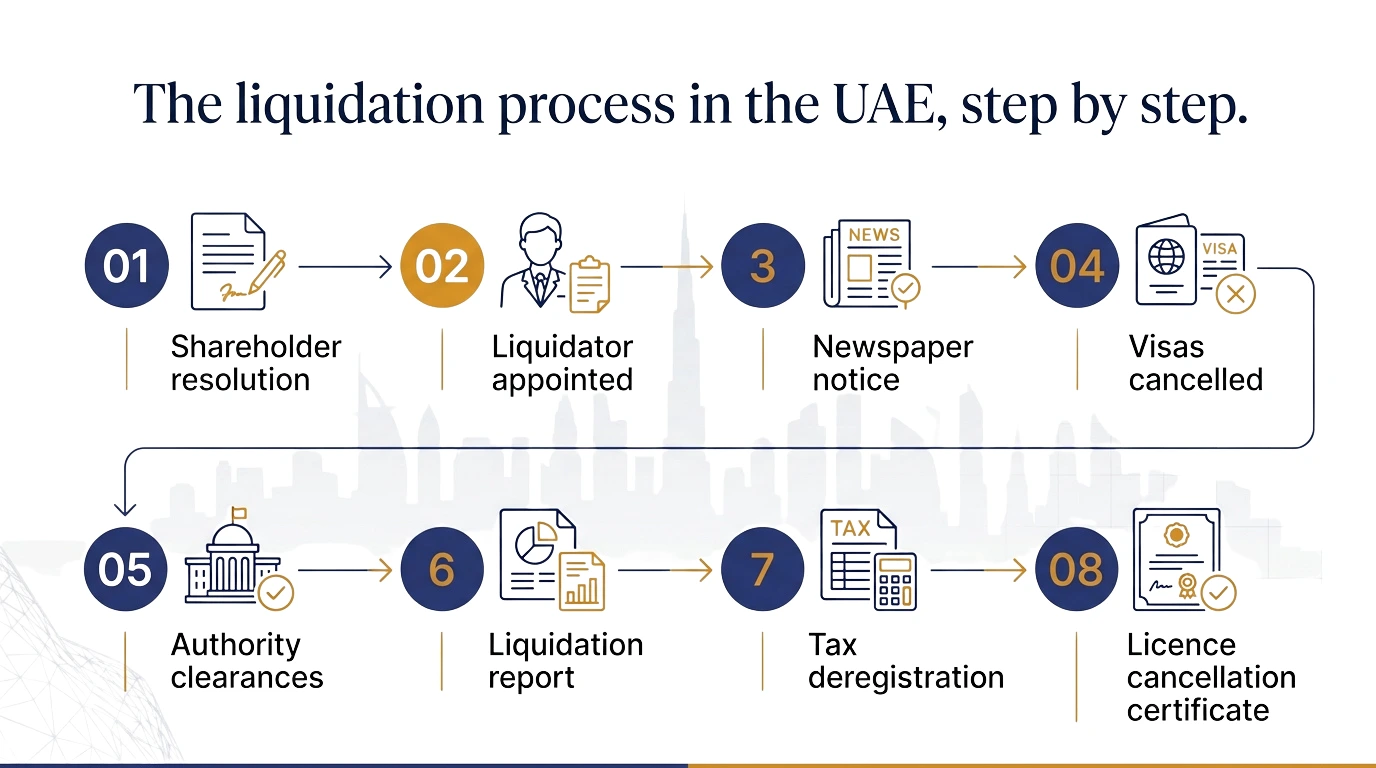
We appoint the liquidator and sign the final audited report ourselves — no hand-off, no waiting on a third firm.
Immigration, labour, utilities, landlord, bank and FTA. A missed clearance stops the cancellation at the last step.
Closing accounts require records. Where books are behind, we reconstruct them as part of the same project.
Deregistration filed so no corporate tax or VAT obligation survives the company.
Scoped and quoted up front. Closures are exactly the kind of work that becomes open-ended on hourly billing.
If yours already expired and penalties have accrued, that is a common starting point rather than a disqualifier.
Eight stages, each gating the next — and what a liquidation report actually is.
Closing a UAE company is a sequence, and each step gates the next. Skipping to the end is what leaves entities half-closed for years.
Timelines differ by jurisdiction: see mainland liquidation and free zone liquidation.
A formal statement by the appointed liquidator confirming the company’s closing position — that liabilities have been settled, assets properly dealt with, and there is nothing outstanding that would prevent closure. The licensing authority will not cancel a licence without it.
It is an assurance engagement, not paperwork. The liquidator is attesting to the position, which is why they will insist on reconciled records before signing. Where records are incomplete, the work starts with rebuilding them.
The liquidation process in the UAE runs in a fixed sequence, and skipping a step does not save time — it stops the file. A shareholder resolution appoints a liquidator, the licence is provisionally cancelled, a notice period runs for creditors, clearances are collected from immigration, labour, utilities and the tax authority, a liquidator’s report is issued, and only then is the licence finally cancelled.
On cost: the trade license cancellation cost in Dubai is rarely the government fee people budget for. It is the accumulated liabilities that surface during clearance — unfiled corporate tax returns, outstanding VAT, employee end of service entitlements, and penalties that have been quietly accruing on a licence nobody was watching. We have closed dormant companies that cost more to shut than they ever cost to run.
The single most useful thing you can do is deregister for tax properly rather than abandoning the licence. An abandoned licence keeps accruing penalties and can block the shareholders from future UAE activity. See free zone liquidation, mainland liquidation or liquidator appointment for the route that applies to you.
Straight answers, with the caveats that actually matter.
The entity stays on the register and accrues late-renewal penalties indefinitely. Immigration and labour files remain open, and corporate tax and VAT filing obligations continue. Owners typically discover this when applying for a new licence or a visa, by which point the accumulated liability can far exceed the cost of a proper liquidation.
Typically eight to twelve weeks. Free zone closures are usually at the faster end, mainland at the slower. The statutory notice period is fixed and cannot be compressed, so that portion of the timeline is the same for everyone.
The entity must be able to settle its liabilities, or arrangements must be made with creditors. If it cannot, that is a different legal route with different consequences — tell us at the outset rather than partway through, because the approach changes materially.
Yes. The final liquidator report must be audited and signed by a licensed auditor. We hold that licence, which is why the process runs faster with us than with a firm that has to outsource the report.
Common, and workable. We assess the accumulated penalty exposure first so you know what you are facing, then either regularise and liquidate, or liquidate directly depending on the authority and how long it has been. Acting sooner always costs less.
Yes — all residence visas sponsored by the company must be cancelled as part of the process, including yours as owner. If you need to remain in the UAE, plan the transfer to another sponsor before liquidation begins rather than after.
Most clients pair this service with one or more of the following.
The final liquidator report must be audited. We sign it in-house.
Closing accounts need records. We reconstruct backlogs as part of the same project.
Closing one structure to open a better one is a common and sensible reason to liquidate.
Tell us the situation honestly. We will assess the penalty exposure and quote a fixed fee to close it properly.
Tell us the entity type, whether the licence is current, how many visas are attached and roughly where the accounts stand. No judgement — lapsed licences are routine work for us.
Takes under a minute. No obligation, no sales script.
Tell us where you are in the process. We will come back with the right jurisdiction, a realistic cost range and a timeline — no obligation.
[aone_form type="modal"]