
Free zone liquidation is generally faster than mainland closure — fewer counterparties, one authority, and a portal-driven process. What it does not skip is the liquidation audit, the tax deregistration, or the requirement that every outstanding return is filed first.
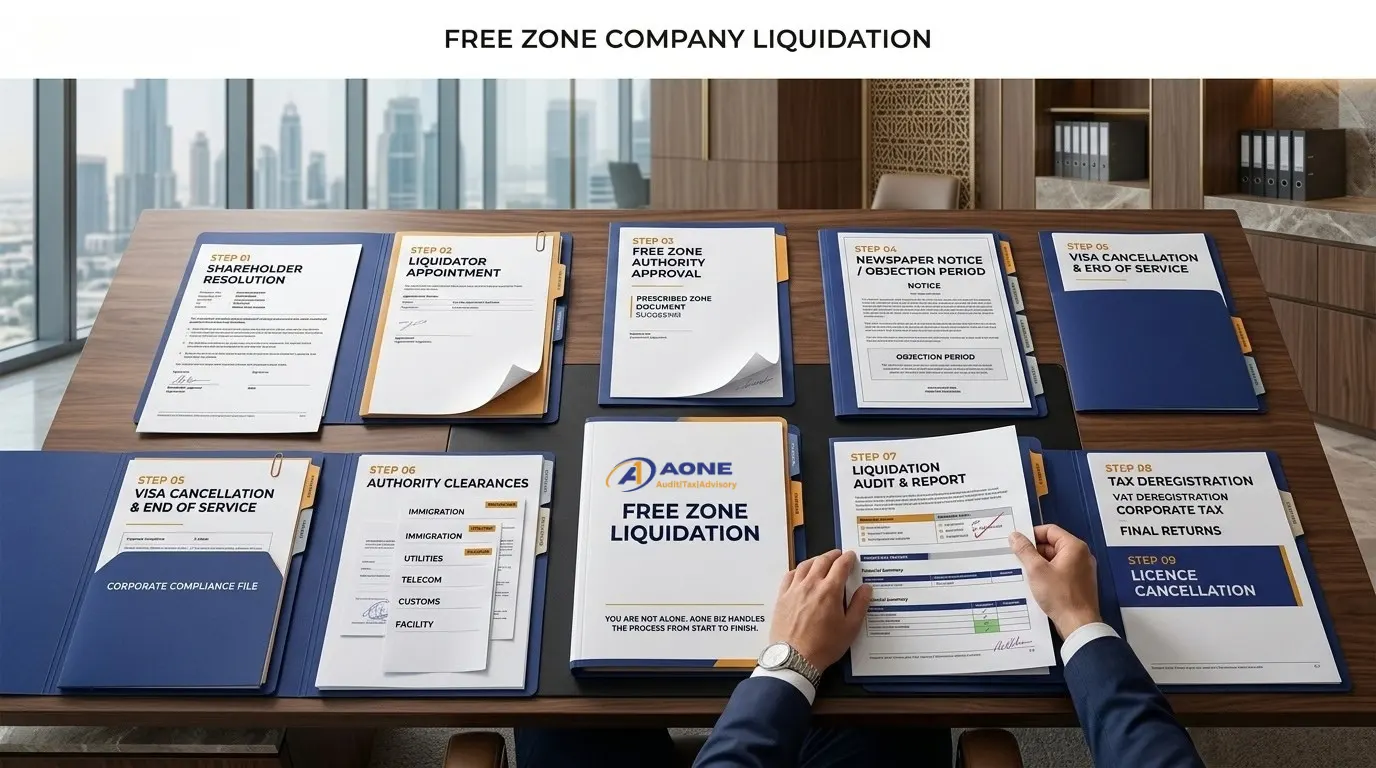
The free zone company liquidation process
- Shareholder resolution to dissolve, in the zone’s prescribed form
- Appoint a liquidator — a licensed audit firm, generally required to be on the zone’s approved list
- Notify the free zone authority and obtain initial approval
- Newspaper notice where the zone requires it, with an objection period
- Cancel visas and settle end of service entitlements
- Clearances — immigration, utilities, telecoms, customs where applicable, and the facility
- Liquidation audit and report issued by the liquidator
- Tax deregistration — VAT and corporate tax, with final returns
- Licence cancellation certificate issued by the zone
The approved auditor requirement applies here too
Most zones require the liquidator to be on their approved auditor register — the same list that governs your annual audit. A liquidation report from a firm not on it can be rejected, exactly as an annual audit would be.
Verify approval before appointing. We hold approvals across DMCC, JAFZA, DAFZA, IFZA, Meydan, SHAMS and RAKEZ, and act as liquidator directly rather than subcontracting the report — see statutory audit services for how the audit side works.
How zones differ
- DMCC — portal-driven with a defined sequence; audited accounts and a liquidation report both required
- JAFZA and DAFZA — similar, with customs clearance mattering more where the entity held stock
- DIFC and ADGM — their own companies law governs the process, which is closer to a UK-style winding up
- IFZA, Meydan, SHAMS, RAKEZ — generally lighter and faster, though the tax deregistration burden is identical
Whatever the zone, corporate tax deregistration follows federal rules rather than the zone’s, so a light-touch zone does not mean a light-touch closure.
Filing history sets the timeline
You cannot deregister for tax with outstanding returns, and the free zone will not issue a cancellation certificate without deregistration.
So a company that ceased trading years ago but never filed cannot close until those years are prepared — sometimes including audits. That work is backlog accounting recovery, and it sits ahead of liquidation rather than inside it. With clean filings, expect two to four months; without them, budget considerably more.
Assets, stock and the customs position
Where the entity held stock in the zone, customs clearance is required and goods must be accounted for — exported, transferred, sold or destroyed with evidence. Goods in a free zone sit outside UAE customs territory, so moving them into the mainland at closure triggers duty and clearance.
Fixed assets need disposing of and recording properly. Where input VAT was recovered on assets still held at deregistration, output tax may be due on them — a step frequently missed in the final return.
Letting the licence lapse is not closure
Non-renewal leaves the entity unresolved with penalties accruing, and the corporate tax obligations remain regardless of the licence status.
Directors and shareholders stay associated with it, which affects new licence applications, visa processing and banking. The cost of proper closure is almost always lower than the accumulated position of an abandoned entity discovered three years later.
Frequently asked questions
Generally yes - fewer counterparties and a single authority. Tax deregistration takes the same time either way.
Yes. A liquidator's report is required, and a liquidation audit is standard practice.
For most zones yes, the same register that governs your annual audit. Verify before appointing.
It must be accounted for - exported, transferred, sold or destroyed with evidence. Customs clearance is required.
Two to four months with clean filings. Outstanding returns extend it substantially, because deregistration cannot proceed without them.
Once cancelled, no. You would form a new entity. That is worth weighing before starting.
Getting started
Tell us your free zone, your last filed return, and whether any stock or assets remain. Those three answers scope the whole closure.