
A statutory audit is the annual audit your licence or the law requires — an independent opinion on whether your financial statements give a true and fair view under IFRS. In the UAE it is what your free zone wants at renewal, what your bank wants at facility review, and what corporate tax requires if you are claiming 0%.

What is a statutory audit Dubai companies need?
An independent examination of your financial statements by a licensed auditor, resulting in a formal opinion. It is not a search for fraud and it is not a review of your business decisions — it is an opinion on whether the numbers fairly represent what happened.
In UAE practice the same engagement is described several ways. External audit describes who performs it. Statutory audit describes why it is required. Financial statement audit describes what is examined. For most UAE companies these all mean the same annual engagement, ending in audited financial statements signed by a licensed auditor.
Who needs one in the UAE
- Most free zone companies — DMCC, JAFZA, DAFZA, DIFC and ADGM require audited accounts at licence renewal. See free zone audit requirements by authority.
- Every Qualifying Free Zone Person — audited statements are mandatory for the 0% corporate tax rate, with no revenue threshold.
- Companies seeking finance — banks require audited accounts for facilities and renewals.
- Businesses bidding for tenders — including anything requiring an ICV certificate, which is calculated from audited figures.
- Companies preparing to sell or raise investment.
Two separate rules now demand audited accounts from most free zone companies — the free zone authority for renewal, and corporate tax for 0% status. Run one audit that satisfies both rather than treating them as separate projects.
IFRS financial statements
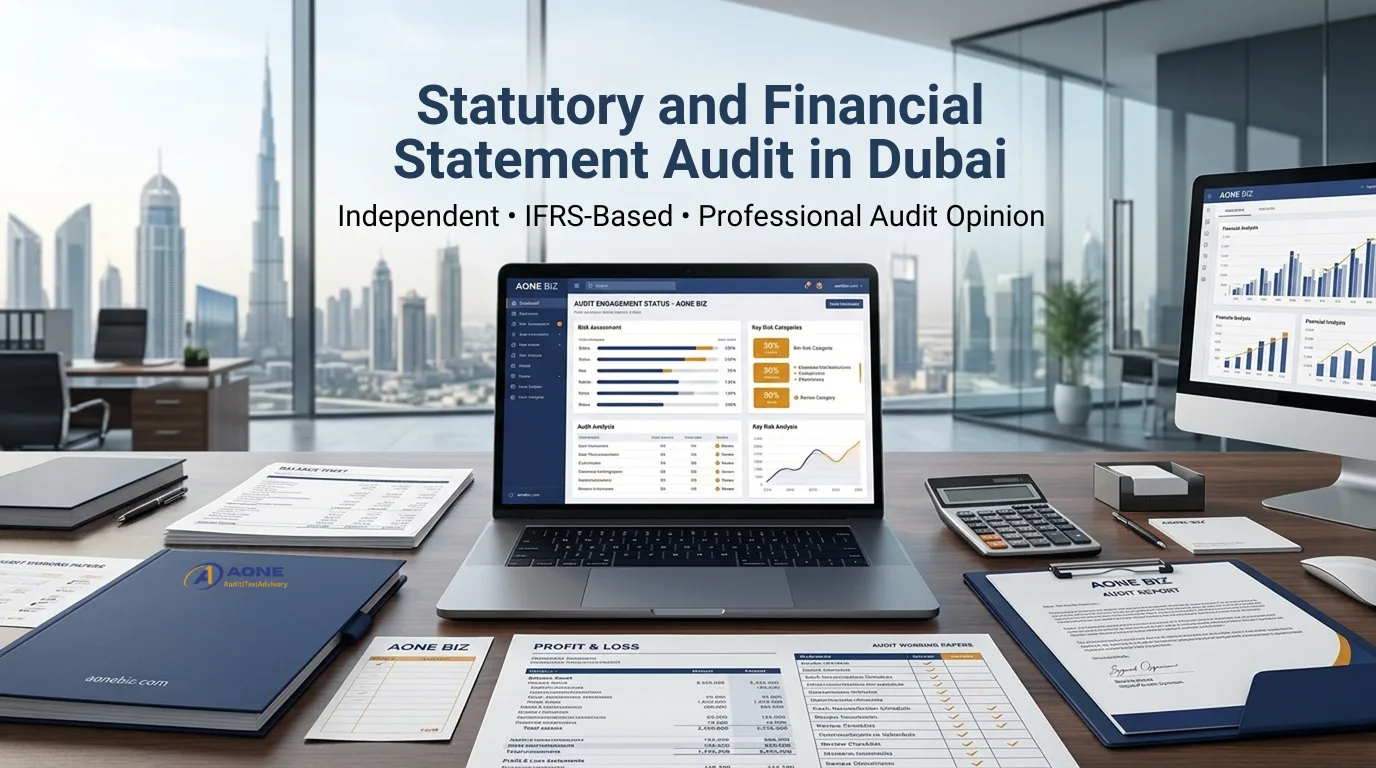
UAE statutory audits are performed against International Financial Reporting Standards. Most SMEs report under IFRS for SMEs; larger and regulated entities under full IFRS.
The distinction matters more than it sounds. Full IFRS carries heavier disclosure, fair value measurement in more areas, and detailed financial instrument requirements. Choosing the wrong framework means restating — expensive and avoidable. We confirm the appropriate framework before fieldwork begins, not after.
How the engagement runs
- Planning and risk assessment — we review your trial balance, understand the business, and identify where material misstatement is most likely.
- Fieldwork — testing balances and transactions, confirming banks and receivables, verifying assets, reviewing revenue recognition and cut-off.
- Review and clearance — queries resolved, adjustments agreed with you rather than imposed.
- Signed opinion — financial statements issued with the audit report, ready for your authority, bank and corporate tax return.
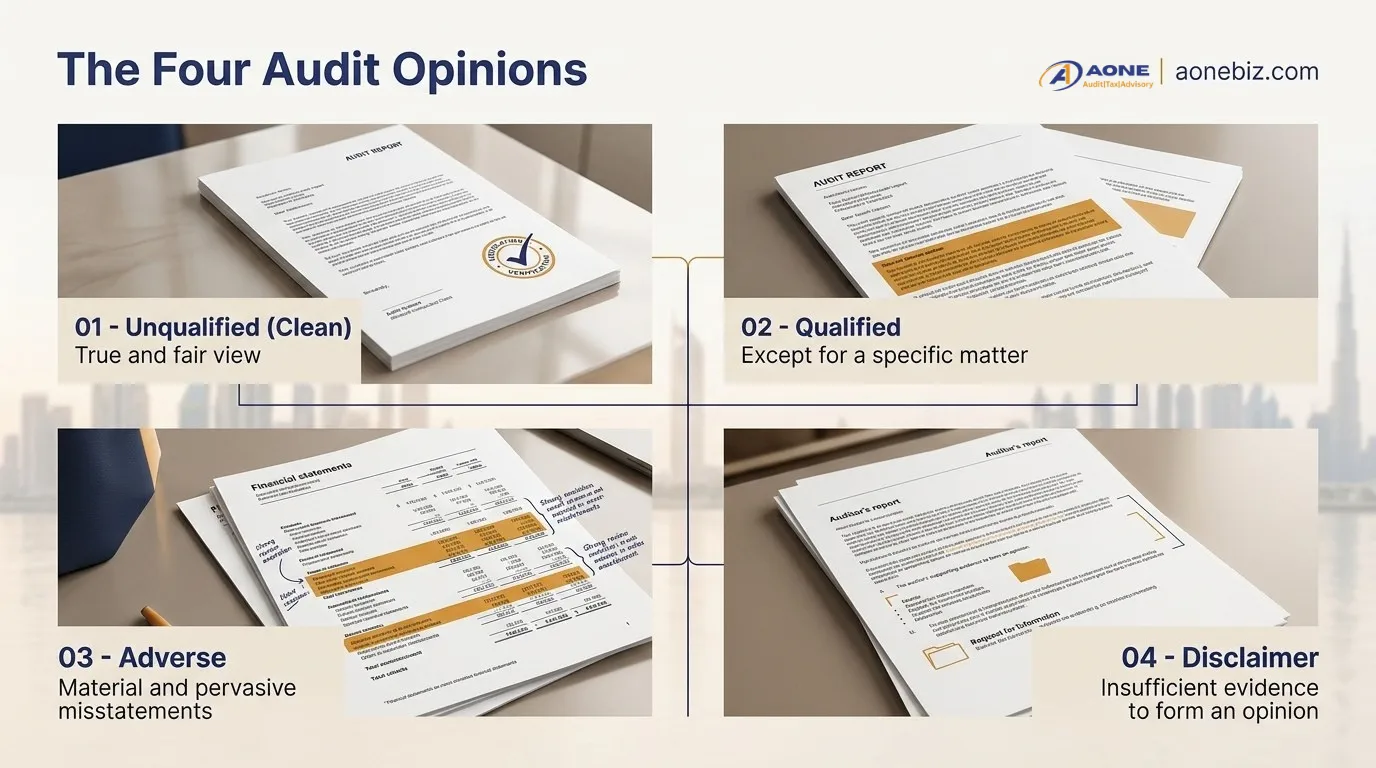
The four audit opinions
- Unqualified (clean) — statements give a true and fair view. What you want.
- Qualified — true and fair except for a specific matter, usually a balance that could not be verified.
- Adverse — statements do not give a true and fair view.
- Disclaimer — insufficient evidence to form an opinion at all.
Qualifications are usually avoidable and almost always originate in records rather than in judgement. Missing inventory counts, unconfirmed related party balances and unreconciled banks are the common causes — all fixable in advance if the bookkeeping is maintained through the year.
What we need from you
- Trial balance agreeing to your ledgers
- Bank statements and reconciliations for every account, full year
- Sales and purchase ledgers with supporting invoices
- Fixed asset register with depreciation
- Lease, loan and related party agreements
- Filed VAT returns, for reconciliation against revenue
- Inventory count records at year end, where applicable
If you cannot produce a reconciled trial balance, the work starts with bookkeeping rather than audit. Paying audit rates for data entry is the most expensive route to a signed opinion.
Timing and fees
Allow three to four weeks for a clean audit, eight to twelve where the year is unreconciled. Fees are driven by transaction volume, the state of your records, entity complexity and deadline pressure — not by revenue alone. Our guide to what drives audit fees in Dubai sets out the detail.
We quote fixed fees against an actual trial balance rather than an estimate, and we tell you upfront what would change the price.
What each free zone expects
Requirements differ by authority, and they change. As a working guide for the zones we file in most often:
- DMCC — audited statements filed annually through the member portal, within a window tied to your financial year end. Late submission affects renewal.
- JAFZA and DAFZA — audited statements required for renewal, with the auditor drawn from the zone register.
- DIFC and ADGM — stricter expectations reflecting the common-law regulatory environment, and a narrower list of registered auditors. See DIFC and ADGM requirements.
- IFZA, Meydan, SHAMS and RAKEZ — historically lighter on renewal, but the corporate tax audit requirement applies regardless of what the zone asks for.
Always confirm against your own licence conditions rather than a general list. Zones update requirements, and the version in circulation is frequently out of date.
Why approved auditor status matters
Most free zones maintain their own register of auditors permitted to sign for entities licensed there. UAE licensing alone is not always sufficient, and the submission portal validates against that register automatically.
The failure pattern is consistent and expensive: the audit is completed, submitted for renewal, and rejected because the signing firm is not on the register. The work is then redone under deadline pressure, at a second fee.
Verify approval for your specific zone before appointing, and re-verify annually — registers change, and firms drop off them. AONE BIZ holds approvals across DMCC, JAFZA, DAFZA, IFZA, Meydan, SHAMS and RAKEZ.
How the audit feeds your corporate tax return
Your corporate tax return is prepared from audited figures, and the two deadlines interact. For a 31 December year end, the return is due 30 September — nine months later.
The sequence that works is books closed by June, fieldwork in July, signed statements in August, return filed in early September. Companies that leave the audit until August end up preparing the return and the audit simultaneously, which is where errors and late filings originate.
There is a second, less obvious link. Your auditor will reconcile filed VAT returns to audited revenue. A mismatch between the two is among the most common triggers for an FTA query, so finding it during the audit is a good outcome rather than a bad one.
Five things that slow an audit down
- Unreconciled bank accounts. The single largest driver of extra hours. Every account, every month.
- No inventory count at year end. This cannot be fixed retrospectively. If you hold stock, count it on the last day and keep the sheets.
- Related party balances with no agreement. Loans and charges between connected entities need documentation, and they also carry disclosure obligations.
- Missing invoices for significant expenses. Bank payment alone does not evidence the nature of a cost.
- Opening balances that were never verified. A first-year engagement requires work on brought-forward figures, particularly where prior working papers are unavailable.
Each of these is preventable through the year and expensive to fix in the weeks before a deadline.
Frequently asked questions
In UAE practice, yes for most companies. External describes who performs it, statutory describes why it is required, and financial statement audit describes what is examined - all the same annual engagement.
No. Most zones maintain their own approved auditor register, and an audit signed by a firm not on it can be rejected at submission. Verify before appointing.
Usually yes, where your zone requires audited accounts at renewal. A dormant audit is quicker and cheaper but still produces a signed opinion.
Yes. Most of our engagements are for completed years. What matters is whether the underlying records exist and reconcile.
An audit is designed to give reasonable assurance that statements are free from material misstatement, not to detect all fraud. Where you have specific concerns, a forensic engagement is the right tool.
It relates to one financial year. Authorities and banks generally expect the most recent completed year.
Start with your trial balance
Send us your trial balance and tell us your free zone and year end. We will confirm whether we are approved for your authority, what the deadline actually is, and quote a fixed fee against your real records.