Free zone audit deadlines, and what missing one actually does
There is no single national audit deadline in the UAE. Each authority sets its own, and almost all of them run from your financial year end rather than a fixed calendar date. Two companies in the same building can have deadlines six months apart.
The table below is a planning aid, not a substitute for your licence. Authorities change their rules, and several publish nothing at all — where that is the case we say so rather than invent a figure.
| Authority | Audited accounts due | What missing it does |
|---|
| DMCC | Within 180 days of your financial year end, via the member portal | Blocks licence renewal; auditor must be on the DMCC approved list — full guide |
| DDA / TECOM (Media City, Internet City, Knowledge Park, Studio City, Design District, DIAC, DSP, DPC, DOC) | Within 6 months of year end — 30 June for a 31 December close | Penalties apply and renewal is affected — full guide |
| JAFZA | Commonly within 90 days of year end | Tied to renewal; portal sanction — full guide |
| DAFZA | Commonly within 3 months, and required at licence renewal | Updated trade licence not issued until filed |
| DIFC | Published guidance varies by entity type and turnover — confirm directly | Regulated environment; tighter filing rules than commercial zones |
| SAIF Zone | Required at renewal; commonly 6 months for FZE and FZC | Updated trade licence withheld — SAIF Zone setup |
| RAKEZ | Required at renewal, commonly within 6 months | Financial penalty and suspension of services on repetition — RAKEZ setup |
| Hamriyah (HFZA) | Required on commercial licence renewal | Updated trade licence not issued |
| DSO | Financial statement and liquidation report required for renewal and clearance | Request held; late renewal fines accrue |
| IFZA / Meydan | Varies by licence category, and has been extended in recent years rather than reduced | Re-check before relying on advice given at incorporation — full guide |
| SHAMS and several Sharjah / Ajman / UAQ zones | Accounts must exist and be retained; not always collected annually | Produce on request; still required for the 0% claim — full guide |
| Mainland (DED) | No blanket annual filing requirement | Commercial Companies Law still requires proper books; banks, investors and the FTA request audited accounts routinely |
The important correction: in most zones the consequence of filing late is not a fine you can absorb. It is a blocked licence renewal — which in turn affects visa status, establishment card validity and, eventually, your bank account. That is why we diarise from the year end rather than the deadline. See what to do if you have already missed one.
Your audit deadline is not your corporate tax deadline
Companies plan for one and miss the other constantly. Your corporate tax return is due nine months after your year end. Most zone audit deadlines fall three to six months earlier. One audit can support both — but only if it is planned to the earlier date.
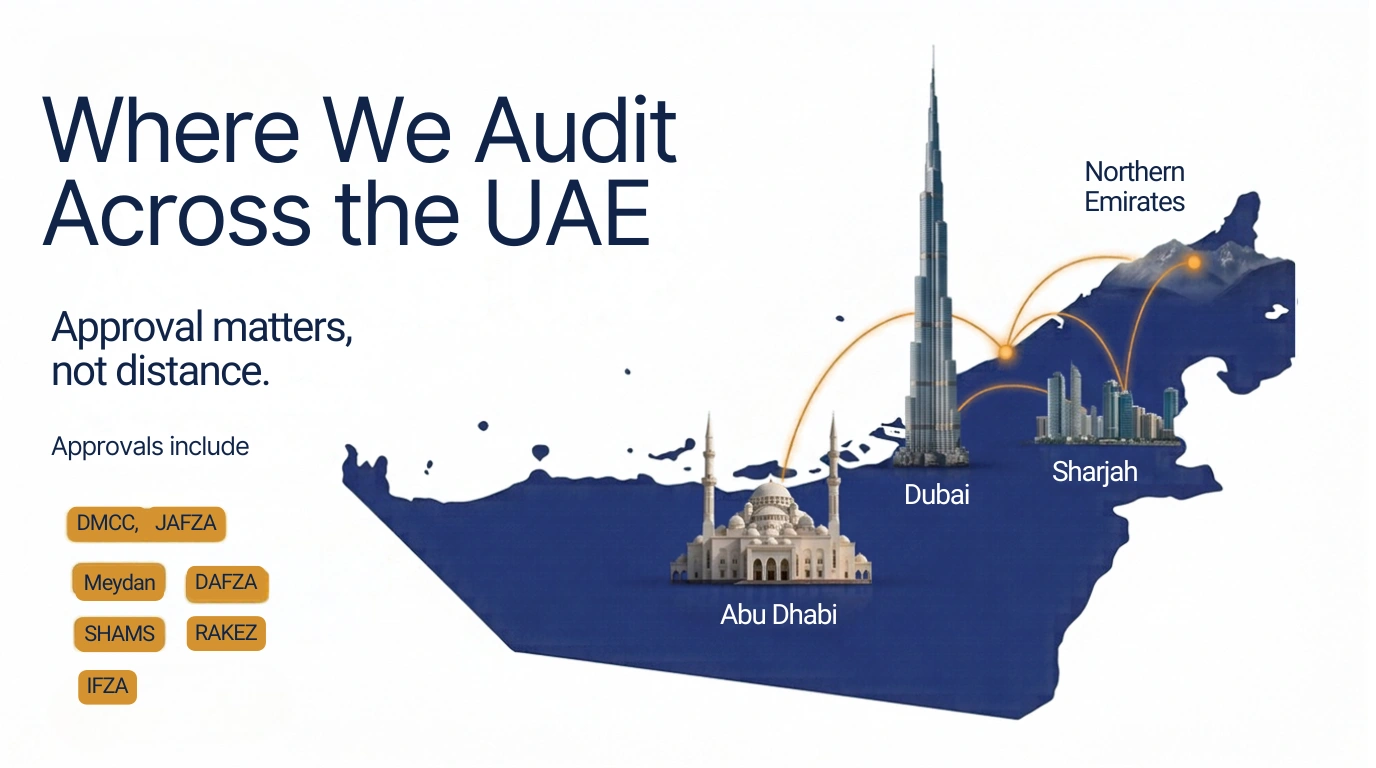
Audit services across all seven emirates
We audit mainland and free zone companies throughout the UAE. Where we hold a physical presence we say so; where we do not, we say that too.
Audit firms in Dubai
Our base. Mainland DED companies and free zone entities across DMCC, DAFZA, JAFZA, DDA/TECOM, IFZA, Meydan, DSO, DWTC and Dubai South. Most of our work sits here.
Audit firms in Abu Dhabi
We serve Abu Dhabi mainland, ADGM and the Abu Dhabi free zones including Masdar City and KIZAD, and we handle ICV certification for ADNOC and government tenders. We do not maintain an Abu Dhabi office and would rather say so plainly — see how we serve Abu Dhabi clients.
Audit services in Sharjah
A genuine office at Sharjah Media City. We audit SHAMS, SPC, SAIF Zone, Hamriyah and Sharjah mainland companies — see our Sharjah practice.
Audit services in Ajman, Umm Al Quwain, Ras Al Khaimah and Fujairah
The northern emirates zones — Ajman Media City, Ajman Free Zone, UAQ FTZ, RAKEZ, RAK ICC, Fujairah Free Zone and Creative City — are served from Dubai and Sharjah. For an annual audit that is rarely a constraint: the fieldwork is largely on records, not premises.
Approved auditor status: what to check before you appoint anyone
Most free zones maintain a list of auditors whose reports they will accept. Submitting a report signed by a firm not on your zone’s list means the submission is rejected and you commission a second audit, under deadline pressure, at a second fee.
Three checks, in this order, whichever firm you are considering:
- Ministry of Economy registration. The baseline. A firm not registered to practise cannot sign an audit opinion in the UAE at all.
- Your specific zone’s list. Ask for it in writing, and verify against the zone’s own published list rather than the firm’s website. Lists change.
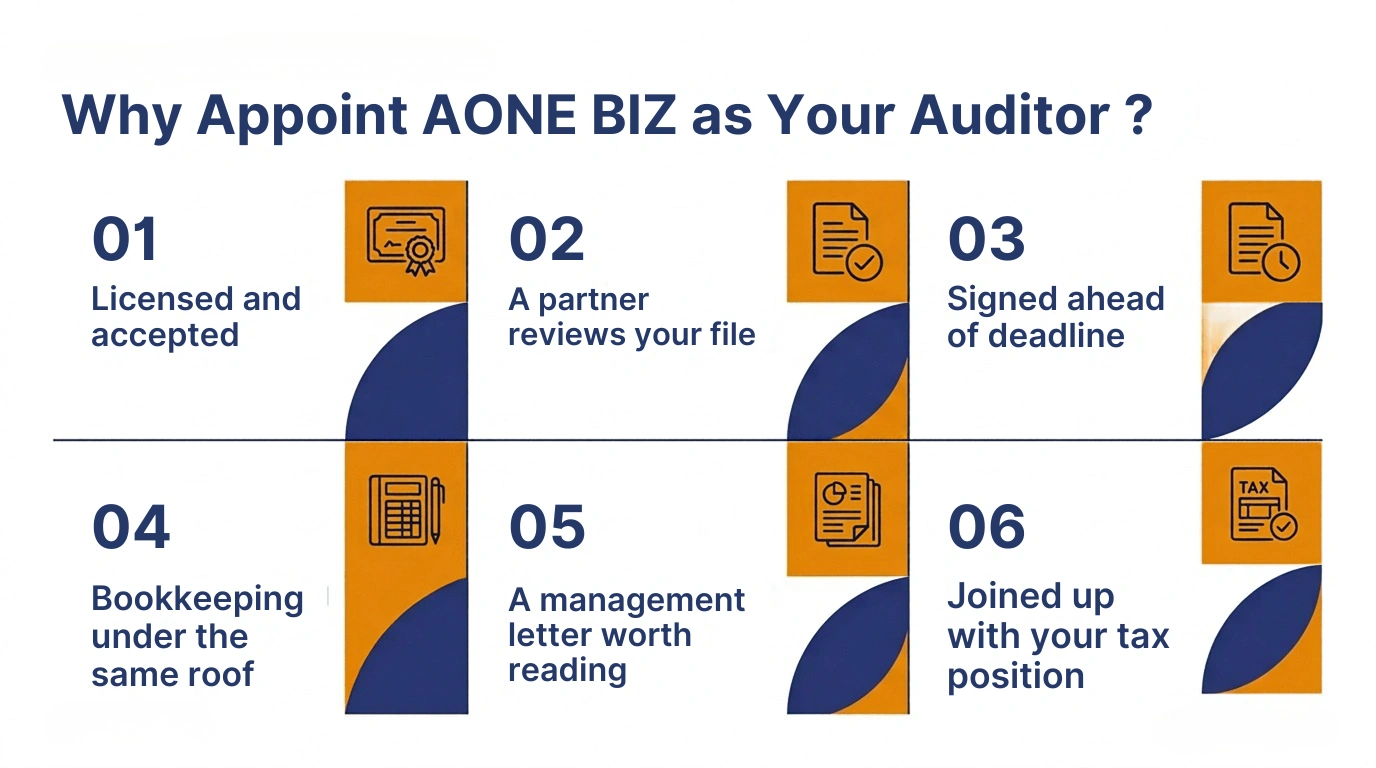
- Whether the signing partner will actually read your file. Not a regulatory question, but the one that decides whether the audit is useful or merely compliant.
We are registered with the Ministry of Economy as licensed auditors, and our reports are accepted across the major UAE free zones. If your zone requires a firm on its own approved panel, ask us directly about that zone and we will tell you plainly whether we are on it — rather than listing zones and leaving you to discover the answer at submission. Our guide to DMCC approved auditors explains how these lists work in practice.
Every audit engagement, in detail
Each engagement has its own page, because the questions differ:
- Statutory audit — the IFRS financial statement audit your licence and 0% claim depend on
- External audit — the independent opinion banks, zones and investors ask for
- Internal audit — controls and risk, reporting to your board
- Tax audit and FTA support — when the Federal Tax Authority examines your returns
- Revenue audit — verifying reported income for cash businesses, franchises and revenue-share contracts
- Interim audit — mid-year assurance, and a way out of the year-end crush
Not sure which you need? How to choose an audit firm sets out the questions to ask us and everyone else on your shortlist.